
The Netherlands is a wonderful country. There is broad-based prosperity, accessible healthcare, strong social security, and beautiful nature. We should be proud of this, because decades of hard work have gone into building this prosperity. Our small kingdom is the eighteenth largest economy in the world and the fifth largest in Europe. With a gross domestic product (GDP) of around EUR 63,000 per person, we are among the wealthiest countries in the world and, more importantly, 87.5% of our population describe themselves as happy.
But this offers no guarantee for the future. Dark clouds are gathering over the Netherlands. The deadliest conflict in Europe since the Second World War has ended the peace dividend of recent decades. Our ageing population poses major challenges for our healthcare and pension systems, and we are not yet halfway through the transition to a climate-neutral society. We also need to modernise our infrastructure, build more affordable housing and reverse the declining trend in the quality of our education. This calls not for one-off measures, but for structural choices that keep society affordable.
Meeting these challenges requires economic growth of at least 1.5% to 2% per year. That is the minimum level to keep pace with rising expenditure, but leaves no room for improvement in our purchasing power, better social services and further investment for the future. However, projections by the Netherlands Bureau for Economic Policy Analysis (CPB) show that the Dutch economy will grow by only 0.9% per year in the medium term. Achieving the additional growth needed is not easy. To do so, at least EUR 151 to 187 billion in additional, largely private investment will be needed up to 2035. This investment challenge is central to this report: without this boost, our future (broad-based) prosperity will decline.
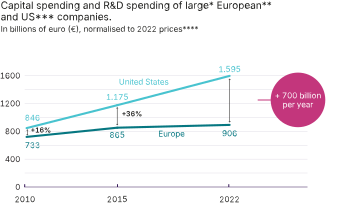
International developments are making this challenge even more acute. The United States and China are rapidly increasing their lead in critical technologies. While they are investing heavily in technological self-sufficiency and dominance in critical technologies such as artificial intelligence (AI), semiconductors, drones and biotechnology, the Netherlands is falling further behind. The gap in investment by large European and American companies has grown from 36% to 76% in seven years, to EUR 700 billion per year.
Mario Draghi sounded the alarm last year about Europe's competitiveness. The following two chapters show that the situation in the Netherlands is also critical. For our future prosperity, it is absolutely essential that we pursue economic growth and increase our strategic relevance. This is not an abstract goal, but a precondition for keeping the Netherlands a prosperous, safe and liveable country in the future.
The Netherlands finds itself at a decisive moment in its economic development. In order to fund our societal transitions, we must generate at least 1.5% to 2% economic growth. The key to this growth lies in rising labour productivity, which requires at least EUR 151 to 187 billion in productivity-enhancing investments. By directing these investments towards socially important domains, everyone can benefit.
"If you don't count technologically, you don't sit at the table - and if you don't sit at the table, you're on the menu."
- Peter Wennink
The Netherlands and Europe are rapidly falling behind China and the US technologically. To remain strategically relevant, the Netherlands must build technological niche positions in four domains: digitalisation and AI, security and resilience, energy and climate technology, and life sciences and biotechnology. This requires significantly higher R&D investments and a much more effective translation of scientific knowledge into commercial applications and scalable businesses.
Read or download the full report in PDF.
